

FACT strip: dissolved solvent profiling in bedrock
FLUTe Activated Carbon Technology: a filter strip with activated carbon that shows where in the borehole dissolved chlorinated solvents are found.
Dissolved chlorinated solvents in the groundwater
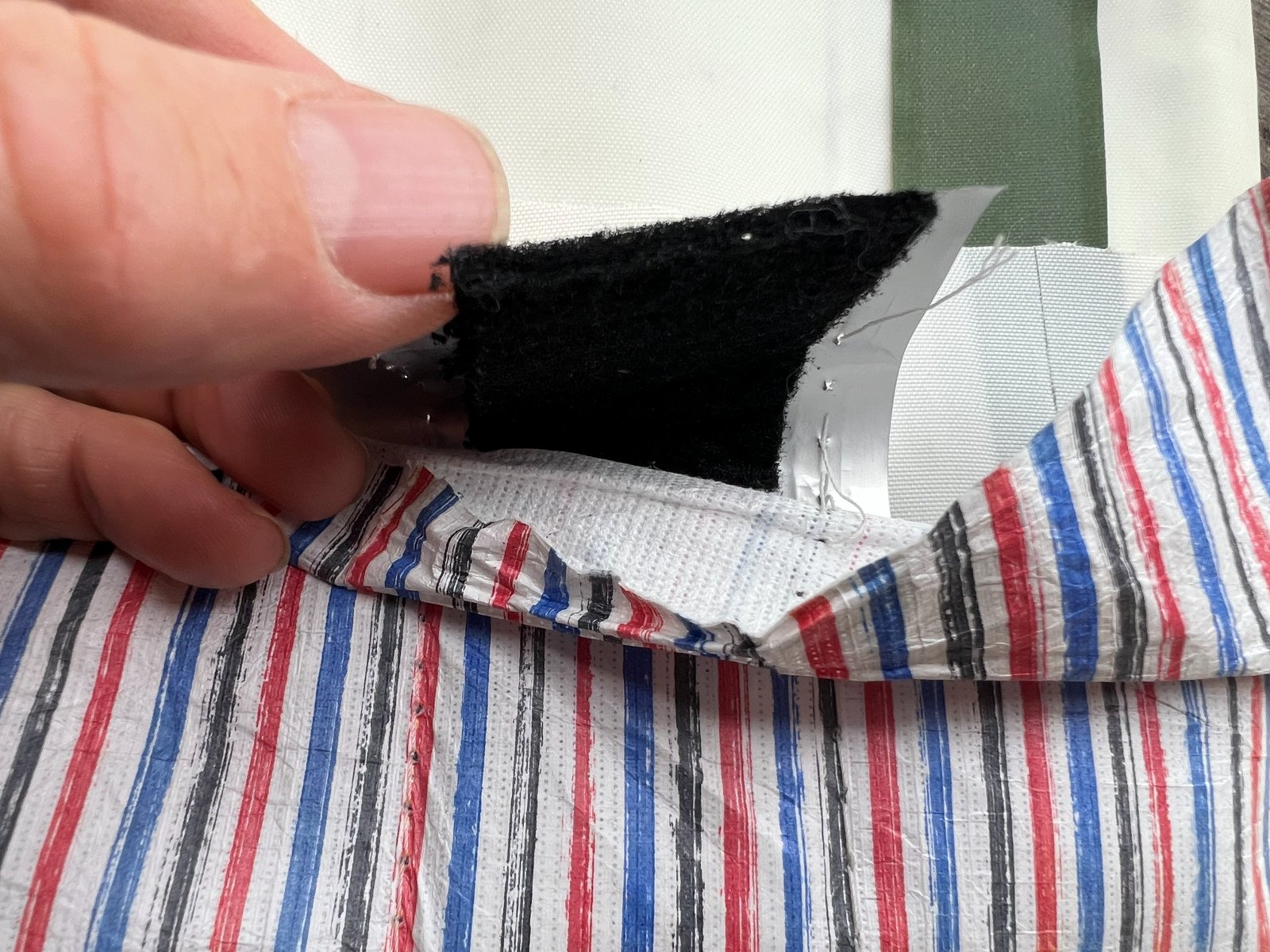
FACT (FLUTe Activated Carbon Technology) is a felt fabric strip impregnated with micro-granular activated carbon, sewn into a Mylar pocket on the outside of the NAPL FLUTe liner. The strip follows the liner down the borehole and is pressed against the borehole wall, opposite the fractures. Here the activated carbon absorbs any contaminants transported with the groundwater in the fracture in question. The hydrostatic overpressure created by filling the liner with a few extra metres of water above the standing groundwater level in the borehole prevents vertical transport of potentially contaminated groundwater in the borehole.
The carbon binds chlorinated solvents from the water moving in the open fractures. After a couple of weeks in the borehole, the liner is retrieved.
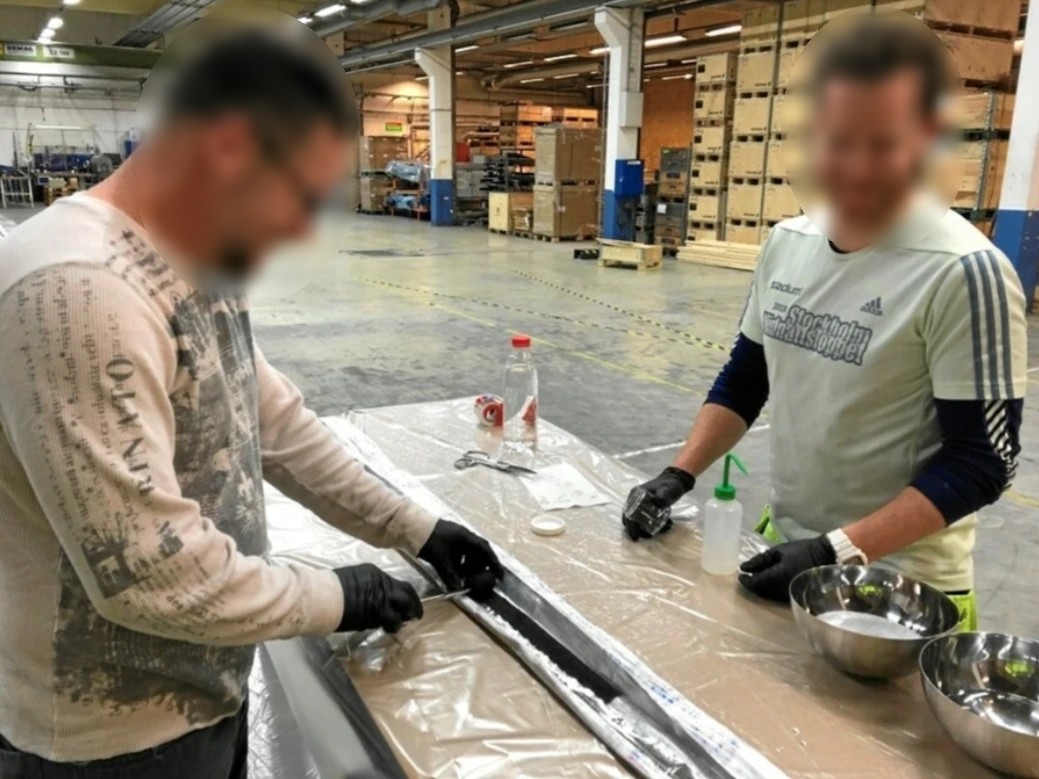
Once the FLUTe Liner has been retrieved from the borehole, the NAPL FLUTe Liner with the sewn-in FACT strip is removed promptly. The Mylar pocket is cut open and the FACT strip is cut to suitable lengths and transferred to glass jars for transport to the laboratory for analysis. Depending on the requested resolution of the contamination situation in the bedrock, the strip is cut into 33, 50 or 100 cm lengths. The whole strip, from where the liner leaves the casing down to the bottom of the borehole, is submitted to the laboratory for analysis. It is not possible to guess in advance which areas are contaminated, and important information can be lost if sections of the borehole are skipped. The outcome is a profile of the solvent distribution in the bedrock fractures but also its degradation products with depth.
From fracture to concentration profile
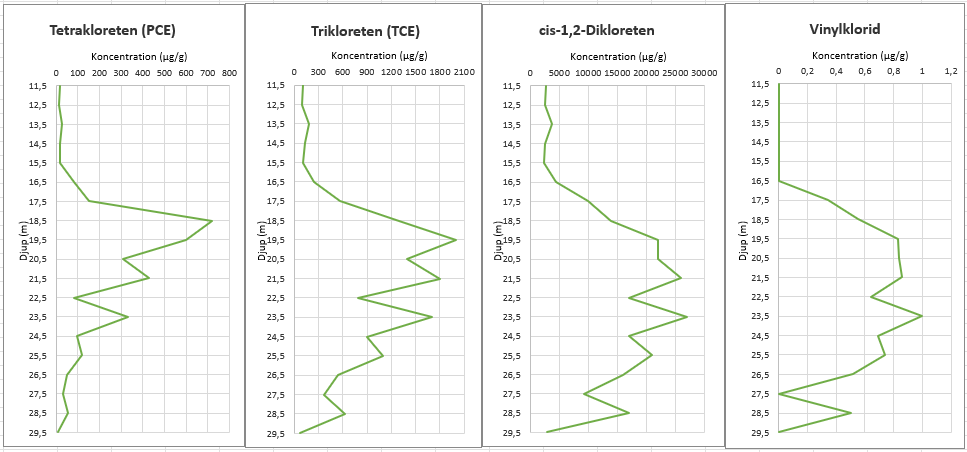
The animation shows how water-bearing fractures are identified when the liner is lowered, how the FACT strip stays in place for two weeks and how the analysis then gives a profile for PCE, TCE and cis-1,2-DCE. The peaks in the profile coincide with the fractures. The curves are a generalised example.
What the profile is used for
The FACT strip is outstanding at identifying water-bearing fractures containing dissolved chlorinated solvents. Analysis of the FACT strip gives not only which parent compound is present but also all the degradation products present, which provides guidance on how further studies should be carried out.
The results show to what depth the contamination has reached, what degree of anaerobic degradation has occurred, and where groundwater samples can be collected to give exact concentrations of contamination in the groundwater before installation of Cased Hole Samplers. Ahead of a remediation, they answer whether bioremediation may be worth considering, or to what depth thermal elements should be placed to get below the plume.
How PCE and TCE are broken down
PCE and TCE are mainly broken down anaerobically, through reductive dechlorination. Under oxygen-free, reducing conditions microorganisms replace one chlorine atom with a hydrogen atom in each step: PCE becomes TCE, then cis-1,2-DCE, vinyl chloride (VC) and finally ethene. Where oxygen is present, cis-1,2-DCE and vinyl chloride can instead be oxidised to carbon dioxide and chloride, and TCE can be broken down as a side effect in some bacteria. PCE is in principle not broken down aerobically.
The FACT strip is analysed for both the parent compounds and the degradation products. The distribution between PCE, TCE, cis-1,2-DCE and vinyl chloride therefore shows how far the degradation has come in each fracture. If the degradation stops at cis-1,2-DCE or vinyl chloride these can accumulate, and vinyl chloride is carcinogenic and therefore particularly important to follow.
Anaerobic (top) and aerobic (bottom) degradation of PCE and TCE. The first four substances are those reported in the FACT results. Only Dehalococcoides is able to break down the last step (DCE to VC) in the anaerobic chain.
Which substances are analysed?
The FACT strip is analysed with FLUTe's comprehensive package for volatile, mainly chlorinated and brominated, organic compounds. The package covers 67 different substances, including the entire anaerobic degradation chain for perchloroethene/PCE and trichloroethene/TCE (highlighted). Many solvents are also contaminated from the start with other chlorinated substances, which are also identified with this package.
- 1,1,1,2-Tetrachloroethane
- 1,1,1-Trichloroethane
- 1,1,2,2-Tetrachloroethane
- 1,1,2-Trichloroethane
- 1,1-Dichloroethane
- 1,1-Dichloroethene
- 1,1-Dichloropropene
- 1,2,3-Trichlorobenzene
- 1,2,3-Trichloropropane
- 1,2,4-Trichlorobenzene
- 1,2,4-Trimethylbenzene
- 1,2-Dibromo-3-Chloropropane
- 1,2-Dibromoethane (EDB)
- 1,2-Dichlorobenzene
- 1,2-Dichloroethane (EDC)
- 1,2-Dichloropropane
- 1,3,5-Trimethylbenzene
- 1,3-Dichlorobenzene
- 1,3-Dichloropropane
- 1,4-Dichlorobenzene
- 1-Methylnaphthalene
- 2,2-Dichloropropane
- 2-Butanone
- 2-Chlorotoluene
- 2-Hexanone
- 2-Methylnaphthalene
- 4-Chlorotoluene
- 4-Isopropyltoluene
- 4-Methyl-2-pentanone
- Acetone
- Benzene
- Bromobenzene
- Bromodichloromethane
- Dibromochloromethane
- Bromoform
- Bromomethane
- Carbon disulfide
- Carbon tetrachloride
- Chlorobenzene
- Chloroethane
- Chloroform
- Chloromethane
- cis-1,2-Dichloroethene
- cis-1,3-Dichloropropene
- Dibromomethane
- Dichlorodifluoromethane
- Ethylbenzene
- Hexachlorobutadiene
- Isopropylbenzene
- Methyl-tert-butyl Ether (MTBE)
- Methylene Chloride
- m&p-Xylene
- n-Butylbenzene
- N-Propylbenzene
- Naphthalene
- o-Xylene
- sec-Butylbenzene
- Styrene
- tert-Butylbenzene
- Tetrachloroethene (PCE)
- Toluene
- trans-1,2-Dichloroethene
- trans-1,3-Dichloropropene
- Trichloroethene (TCE)
- Trichlorofluoromethane
- Vinyl chloride
- Xylenes, Total
In addition to the substances above, four control substances (surrogates) are included for quality control: 1,2-Dichloroethane-d4, Toluene-d8, 4-Bromofluorobenzene and Dibromofluoromethane.
FACT in the field
Planning a bedrock investigation?
Contact us for a discussion about how FLUTe Liners can give you a more reliable result.
patrik@rosmarusenviro.com